
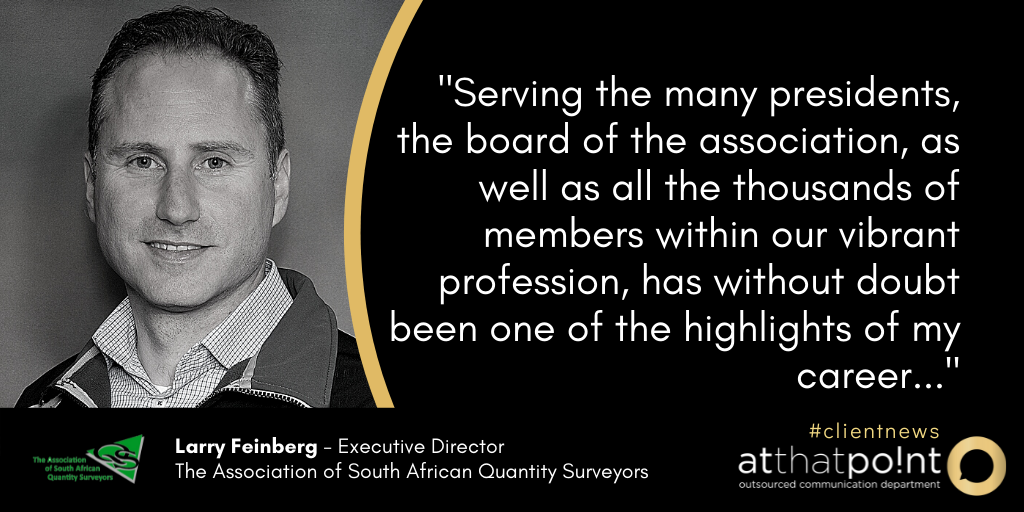
 Larry Feinberg is set to end his decade-long term as Executive Director of the Association of South African Quantity Surveyors (ASAQS) in February 2022. Prior to leading the ASAQS, Feinberg served as Regional Manager for Africa at the Charted Institute of Building (CIOB).
Under Feinberg’s leadership the ASAQS implemented holistic governance processes, internal administrative policies, procedures and workflows based on recommended best practice. These changes were made to combine the rich 114-year history of the ASAQS with robust systems that are imperative to today’s business environment. During his term as Executive Director, Feinberg was also instrumental in successfully facilitating the inclusion of South Africa as an Associate Member of the Pacific Association of Quantity Surveyors (PAQS), as well as the signing of Memoranda of Understanding with Hong Kong, Malaysia, Australia, Canada, New Zealand, Royal Institute of Chartered Surveyors (RICS), Malaysia, and the Philippines. Other collaborative partnerships established during Feinberg’s term include the Joint Building Contracts Committee (JBCC), Africa Association of Quantity Surveyors (AAQS), Construction Sector Charter Council (CSCC), and all Voluntary Associations and Statutory Councils within the built environment. The local Quantity Surveyor profession has also benefited from the establishment of the EduTech Division of the ASAQS. The division is responsible for the delivery of all training programmes, the drafting of QS-specific technical documents, and answering any technical related queries. “Serving the many presidents, the board of the association as well as all the thousands of members within our vibrant profession, has without doubt been one of the highlights of my career, and I would like to express my sincere gratitude for the trust and the faith that our members have all placed in me. I reflected on this almost daily while in office and it proved to be an endless source of motivation and encouragement to me. It was the light that always lit the road ahead”, says Feinberg. The ASAQS Board has started the process of recruiting a new Executive Director. ENDS MEDIA CONTACT: Idéle Prinsloo, [email protected], 082 573 9219, www.atthatpoint.co.za For more information on ASAQS please visit: Website: www.asaqs.co.za Facebook: facebook.com/asaqsza Linkedin: linkedin.com/company/asaqs
0 Comments
 Quantity Surveyors are aiming to play a crucial role in getting “frozen” infrastructure development projects back on track. “Municipal managers and classically trained accountants are currently expected to deliver complex projects,” says Larry Feinberg, Executive Director of the Association of South African Quantity Surveyors (ASAQS). “Not only is this expectation unfair on them without them having received the proper training; it’s also part of the reason why some large infrastructure development projects have been suspended or have ground to a halt.”
According to Feinberg the ASAQS has been in talks with senior government officials and other industry bodies to create solutions that can assist with training and professional support to those charged with delivering these projects. “Training on the use of standards documentation is but one of the areas where Professional Quantity Surveyors can be of assistance,” explains Feinberg. “Deploying Professional Quantity Surveyors to upper echelons in government is one of the mechanisms that can be used to good effect to educate officials on good governance in procurement, bidding and tendering processes, and the complex process of managing the construction process from a cost control point of view.” The “Send Me” call made by President Ramaphosa during his State of the Nation address earlier this year has resonated with many and sparked collaborative action across many economic sectors. Feinberg hopes that this call can be used as a basis for professionals in the built environment to bridge focus areas that traditionally operate in and create solutions that serve the best interest of the public and the fiscus. “Our interactions on several discussion platforms are focused on how to bridge the gap between what Thuma Mina means for the public sector and how our members can assist,” says Feinberg. The ASAQS has consistently promoted the role of a Quantity Surveyors as one that plays a significant part in curbing instances of fraud and wasteful expenditure. “The time for behaviours that – intentionally or unintentionally – resist collaboration is over,” says Feinberg. “It is now time for all of us to share knowledge and expertise, so we can collectively respond to the President’s call.” 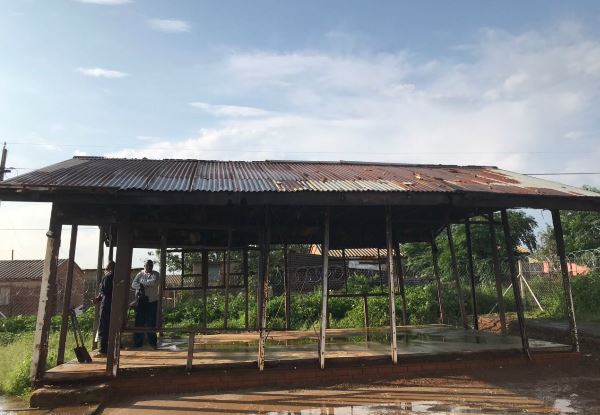 IMAGE: Amanda Khoza, News24 The report of irregular expenditure on the on Winnie Madikizela-Mandela Brandfort is concerning, but commonplace. The Association of South African Quantity Surveyors (ASAQS) says this will only change if the right mix of professionals are appointed at the tender phase of infrastructure projects.
The report by News24 states that “the quantity surveyor's report found fruitless expenditure of R593 622 "with regard to the Winnie Mandela House Project".” “The appointment of a Quantity Surveyor to calculate and oversee projects should not be an afterthought when budget allows,” warns Larry Feinberg, Executive Director of the ASAQS. “We strongly recommend that the appointment of a Professional Quantity Surveyor becomes part of the legislated tender process.” A Quantity Surveyor (QS) is best placed to identify deviations from original tenders in terms of both scope and pricing. As such, they act as the client’s watchdog. In the case of public projects, the client is ultimately the taxpayer. One of the key issues in any public project is to ensure that the tender is awarded to the right contractor at the right price. The training undertaken by Quantity Surveyors allows them to manage the financial and legal processes of a project. “Professional QSs are also bound by a code of conduct,” explains Feinberg. “If they are found to have contravened the code, they will lose their licence to practice as a QS.” ENDS MEDIA CONTACT: Juanita Vorster, 079 523 8374, [email protected], www.atthatpoint.co.za For more information on ASAQS please visit: Website: www.asaqs.co.za Facebook: The Association of South African Quantity Surveyors  The Association for South African Quantity Surveyors (ASAQS) says that Quantity Surveyors are best placed to stem corruption in government infrastructure projects. The first step, says Larry Feinberg, Executive Director of ASAQS, is for both government officials as well as the ordinary taxpayer to understand what the role of a professional Quantity Surveyor (QS) is.
“Globally, construction projects are highly susceptible to cost-overruns, owing to a number of factors. Here in South Africa, as in many other countries, we have the additional problem of corruption, where due process is flouted in order to benefit connected individuals or companies, often during the construction process itself,” says Feinberg. “The person best placed to identify deviations from the original tender in terms of both scope and pricing is the QS and, as such, they act as the client’s watchdog. In the case of public projects, we should remember, the client is ultimately the taxpayer, whose money is being spent—or wasted, in some cases.” Feinberg goes on to say, “In order to have the greatest impact, QSs should be involved right from the initiation stage of the project and also be involved in the planning and feasibility reports in addition to the approval of the actual procurement strategies”. One of the key issues in any project is to ensure that the tender is awarded to the right contractor at the right price. QSs play a critical role here because they are trained to manage the financial and legal processes of a project. During the design stage the QS’s estimate is the tool to ensure the design remains within the budget. During the procurement stage the QS produces the Bills of Quantities (BoQ) on which fair and equitable tenders are based. The BoQ is the ultimate document that provides the client with the knowledge of how much the project is going to cost before construction begins, which is invaluable in judging the tenders before they are awarded. The QS’s professional experience and training makes them the best persons to evaluate tenders. “The BoQ acts as the baseline for the entire project. Any subsequent additions or omissions to the project would also be assessed and costed using the BoQ as the guideline,” Feinberg adds. “The QS then acts as watchdog throughout the course of the project: monitoring progress against the BoQ, authorising payments as work is completed, noting deviations from the tender and, ultimately, producing the final account and be able to defend it to any stakeholder.” National, Provincial and Local Authorities (NPLA’s) are woefully short of experienced and professional QSs thus finding themselves not having enough bandwidth and experienced professional QS’s to manage the many projects at any given time. “Professional QSs are bound by a code of conduct and if they are found to have contravened it, they will lose their licence to practice as a QS,” Feinberg concludes. “This combination of professional discipline, skill and experience makes them the best persons to ensure that a tender is awarded to the right contractor—and that the project is delivered on time and on within budget. In this way, they serve both the NPLA’s and its ultimate boss, provider the taxpayer.” ENDS MEDIA CONTACT: Cathlen Fourie, 082 222 9198, [email protected], www.atthatpoint.co.za For more information on ASAQS please visit: Website: http://www.asaqs.co.za/ Facebook: The Association of South African Quantity Surveyors Enthusiasts are seeing improvements in software as a sign that the days of the quantity surveyor are numbered. Nothing could be further from the truth. By Larry Feinberg, Executive Director, Association for South African Quantity Surveyors  Software has disrupted many industry sectors, from travel to insurance, and from retail to real estate. In each case, we were informed excitedly that the new technology would side-line humans. And yet estate agents, insurance brokers and even brick-and-mortar retail stores all still continue to grow.
More accurately, those that have embraced the new technology have gone on to flourish. When it comes to quantity surveying we are seeing something like the same dynamic unfolding. An added element is that the profession is poorly understood by other players in the public and private sectors. Too often, quantity surveyors are seen simply as providers of Bills of Quantities and drafters of tender documents. In reality, a quantity surveyor has a much broader and more valuable role to play, especially in these days of mega-projects, strict regulation and, of course, unremitting cost pressure. It is true that intelligent software can help automate and improve some of the more routine elements of the quantity surveyor’s job, such as measurement and the collation of documents. But to see the role of the software in this light only, or even to see it to some extent replacing a quantity surveyor, is to miss the point entirely. Rather, the software should be seen as providing quantity surveyors with the space to provide the services that have, over time, come to define their real contribution to any project. This contribution includes the ability to determine the viability of a project from the outset, or to see the project holistically, in order to assist the owner to balance the architect’s vision with the realities of meeting cost targets that will ensure that planned returns are realized. This contribution continues, not only during the actual construction phase but throughout the entire life cycle of the building. I always think of the quantity surveyor’s role as one of creating a value proposition that extends from the design phase, through the construction phase and then ultimately throughout the life of the building management phase. Software alone, would be hard pressed to provide all these vital service solutions to clients. In addition, the quantity surveyor is able to take the basic data and calculations produced by the software as the basis for exercising his or her judgement—not, as many would have one believe, to bypass it. Software cannot take into consideration many of the long-term questions that are of increasing importance to those who fund large projects, and those who will use them. For example, what are the benefits of spending more during the construction phase in order to reduce costs over the life of the project? How can certain needs such as air conditioning be met in a way that it is environmentally responsible without compromising operational efficiency—or commercial viability? These, and similar questions, need the expert judgement of an experienced professional to resolve, not the wired-in certainties of a piece of software. By fulfilling this role, the quantity surveyor protects the interests of the client, including those who will use the finished product, and the broader community at large. ENDS MEDIA CONTACT: Cathlen Fourie, 082 222 9198, [email protected], www.atthatpoint.co.za For more information on ASAQS please visit: Website: http://www.asaqs.co.za/ Facebook: The Association of South African Quantity Surveyors by |
Archives
July 2024
Categories
All
|


 RSS Feed