
For many South Africans that are formally employed in both the government and private sectors, mid-year marks a pivotal time for mid-year salary reviews and potential raises. It is a time brimming with anticipation and hope, as employees look forward to some financial relief for their hard work and dedication. However, the economic landscape is a complex and ever-shifting terrain. “Whilst the inflation outlook has improved over the last few months with CPI averaging 3.0% as at April 2025, there’s a lot happening both locally and globally that impacts employers’ ability to meet everyone’s salary increase expectations,” says Lindiwe Sebesho, Master Reward Specialist and Executive Committee Member at the South African Reward Association (SARA). She advises that employees manage their expectations by understanding the economic factors at play. This understanding can lead to more constructive and better-informed salary conversations, ultimately fostering a healthier employer-employee relations environment focused on driving much needed productivity for the country. Know the factors at play Employers' ability to increase salaries is influenced by several factors, including national and global economic growth prospects, company performance and affordability, as well as skills market trends. Inflation is expected to remain moderate and within the South African Reserve Bank’s 3-6% target range through 2025/26. However, even with recent cuts, interest rates remain high, making debt expensive for individuals and organisations alike, and leaving both employees and employers under financial strain. While we dodged the VAT bullet, the increase to the fuel levy will still hit everyone hard, from individual motorists to company and public service fleets. This cost might be offset by expectations of lower fuel prices but will still have an adverse impact on expenses. Additionally, rising food costs due to droughts and other climatic factors will put further pressure on budgets. Employers will also be hampered by weaker GDP growth than previously predicted, as well as global economic instability fuelled by US President Trump’s on-again-off-again tariffs. Tariffs on South Africa’s trading partners could create unwelcome local inflation, making organisations wary of committing to higher labour costs. "Considering the present economic circumstances, a balanced approach to salary adjustments is required. The intention is not to undervalue employees but to explore comprehensive strategies for improving the overall employee value proposition in a manner that ensures business sustainability and job security," says Sebesho. Given these facts, you may need more information to optimise your remuneration package beyond just a salary increase. Take a positive approach Despite economic pressures, you can improve your odds by taking some simple steps, such as:
Keep it real and respectful While you may be desperate for, expecting or even demanding an above-inflation increase, it is important to be realistic and, especially, respectful during a salary increase conversation. Employers are also strapped due to economic conditions and understanding their limitations without over-comprising yourself will be appreciated. Sebesho concludes, "It is essential to expect fair and equitable pay that allows you to participate effectively in the economy. However, understanding both perspectives is crucial for balanced salary adjustment negotiations that ultimately safeguard employment." She invites readers to engage constructively on the topic and to consider broadening remuneration insight through the SARA Thought Leadership Quarterly and the SARA conference (add links to website) ENDS MEDIA CONTACT: Idele Prinsloo, [email protected], 082 573 9219, www.atthatpoint.co.za For more information on SARA please visit: Website: www.sara.co.za X: @SA_rewardLinkedIn: South African Reward Association Facebook: SARA – South African Reward Association
0 Comments
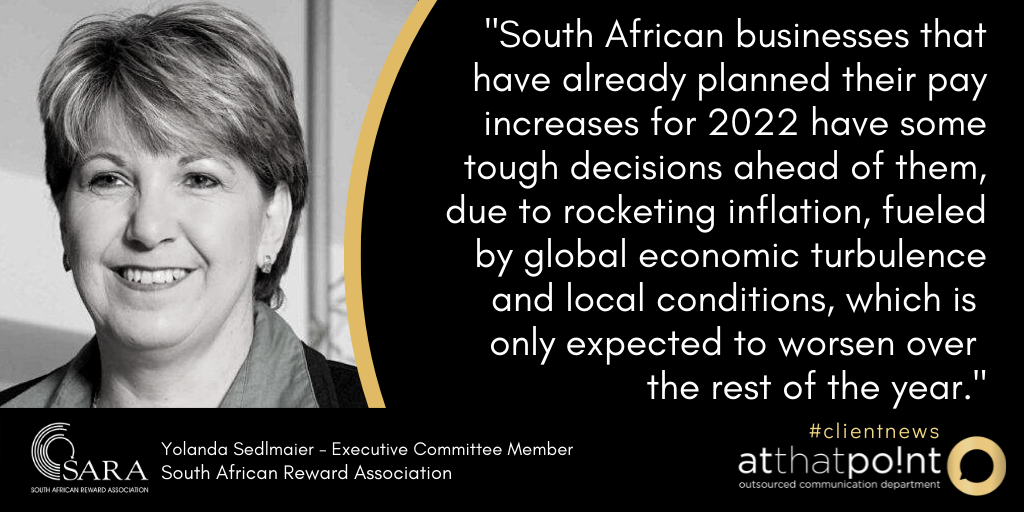
"South African businesses that have already planned their pay increases for 2022 have some tough decisions ahead of them," warns Yolanda Sedlmaier, Chartered Reward Specialist and Exco member at the South African Reward Association.
This is due to rocketing inflation, fuelled by global economic turbulence and local conditions, which is only expected to worsen over the rest of the year. Employees faced with the escalating cost of living may be underwhelmed and demotivated by increases falling well below their needs. Unfortunately, this can negatively affect their productivity as well as that of their company. A rough road ahead South African employers determine their pay increase targets several months before those increases are due to be implemented. The targets are typically based on various factors, including the prevalent economic outlook for the coming year at that time. Once set, sudden changes to the forecast factors are very difficult to accommodate due to the time needed to rework the plans and the financial provisions supporting their adoption. "The process is the definition of a big ship turning slowly and 2022 is shaping up to be just that kind of situation," says Sedlmaier. According to recent figures from Statistics South Africa, the country's current annual inflation is 5.9 percent, mainly due to higher food and fuel prices. This is compared to 4.5 percent in 2021. In addition, credit rating firm Moody's has projected that local inflation could reach as high as 8 percent by the end of the year, a figure the US economy has already reached. To offset inflation, the South African Reserve Bank (SARB) has announced an increase to the interest rate of 50 basis points, following three consecutive rises of 25bps each. The SARB also noted that economic growth had been adjusted from 2 percent down to 1.7 percent due to several short-term factors, including flooding in Kwa-Zulu Natal and ongoing electricity supply constraints. The sudden onset of Russia's war with Ukraine and the conflict's immediate impact on the global economy is also a significant factor. This while businesses are still fighting back from the effects of the COVID-19 pandemic throughout 2020 and 2021. Lastly, economists report that while the outlook for a global recession was 25 percent at the beginning of the year, this outlook has increased to 50 percent. Others have suggested that such a recession may be mild compared to previous declines, like the 2008 financial crisis. "Either way, employers need to be ready for anything," says Sedlmaier. To revise or not to revise The effects of inflation on worker attitudes can already be witnessed as unions, demanding increases of 7, 10 and even up to 15 percent, are prepared to go on strike against employers offering 6 percent. As a result, will companies be forced to implement interim mini-raises to offset the unforeseen inflationary conditions or even bite the bullet and revise their plans altogether? Can they implement better cost-saving initiatives, such as more work-from-home allowances, to alleviate the burden on workers? "There's no easy answer to the million-dollar question they face and employers will have to dig deep to develop effective reward strategies," says Sedlmaier. ENDS MEDIA CONTACT: Rosa-Mari Le Roux, [email protected], 060 995 6277, www.atthatpoint.co.za For more information on SARA please visit: Website: www.sara.co.za Twitter: @SA_reward LinkedIn: South African Reward Association Facebook: SARA – South African Reward Association |
Archives
September 2025
Welcome to the South African Reward Association newsroom.
Categories
All
|
ALL RIGHTS RESERVED

RSS Feed