
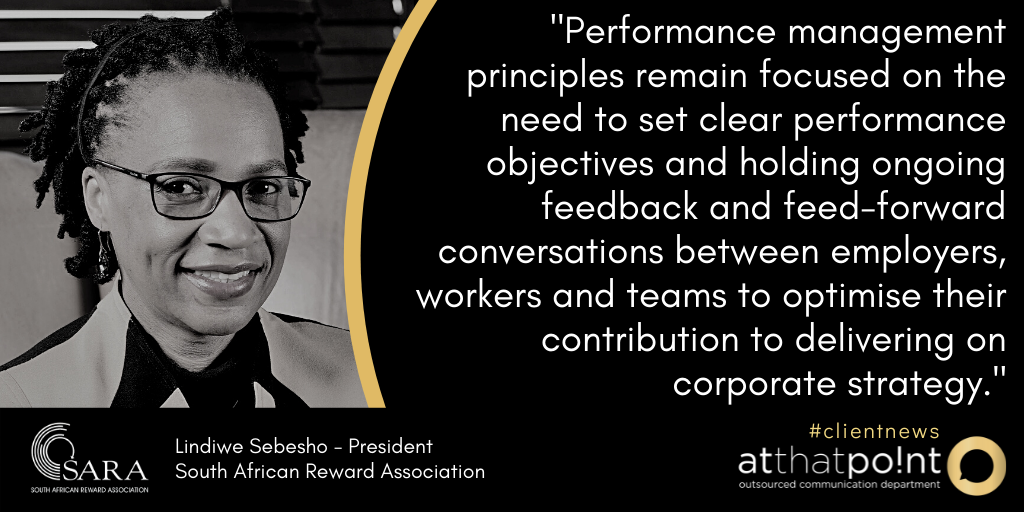
 Apart from the where, when and how of employee performance management, not much has changed since the emergence of COVID-19. This is according to Lindiwe Sebesho, Master Reward Specialist and Executive Committee Member at the South African Reward Association (SARA).
"This is because the key principles in performance management remain relevant in measuring and improving employee contribution to business performance or growth," she says. Performance philosophy Many organisations have become a mix of full time on-premises, fixed-hour staff and work-from-home (WFH) employees with flexible hours. So whilst how their performance is set, monitored and evaluated may be more complex, the need to manage performance remains key for business success. Leveraging technology, most employers are optimising various digital platforms that enable real-time, simple-to-use processes to ease the management of performance across the expanded enterprise. However, performance management principles remain focused on the need to set clear performance objectives and on holding ongoing feedback and feed-forward conversations between employers, workers and teams to optimise their contribution to delivering on corporate strategy. Therefore this process still aims to foster a continuous improvement ethic that focused individuals and teams on activities that drive business growth. Its outcomes are largely still ratings based and are used to inform fair, business-aligned skills development, reward and talent decisions such as succession planning. Key principles Organisations still need to clearly communicate their purpose, growth goals, ambition and strategy within a well-defined business context. Next, they must align employee efforts through personal, team, financial and non-financial objectives and key results (OKRs) that capture essential outcomes. As staff execute their duties, regular check-in conversations and real-time feedback enable development and continuous improvement of performance. Further, regular feedback and ratings should be administered, leading to formal annual evaluations that use an established rating scale linked to desired standards of contribution. These rating outcomes are then used as input for making reward and other talent-related decisions. "Whatever the circumstances, business must not become distracted from this proven approach to performance management even where different working arrangements have been adopted," says Sebesho. Underperformance With the country's economic downturn, organisations are eager to maximise resource output wherever possible. Accordingly there is a more concerted effort towards the proactive management of underperformance among staff. "While managers may have let underperformance slide in the past, they are now more focused On ensuring that every worker contributes to growth consistently," says Sebesho. As part of managing under-performance, it is key to understand the factors that negatively impact employee performance. The first is a lack of skills that could result from an ineffective education system and/or limited investment by employers in training and development. Assigning employees to roles that do not fit their competencies can also hamper optimal performance. Organisations that invest in skilling up workers and ensure employees are equal to their responsibilities can overcome this hurdle. The second is low employee morale and engagement, which can be caused by anything from the threat of retrenchments to rewards that do not align with worker values. The best solution is for management to establish a culture of open communication and engage with staff to determine the causes of poor morale. A show of concern alone can help reignite employee interest, although employers must follow through with solutions to maintain trust. Even workers with good morale may suffer from the third factor, a lack of motivation. This can be caused by societal conditions, such as social unrest or political instability, leading to personal problems, like poor mental or physical health. Employers can offset these obstacles with a comprehensive employee value proposition, additional mental and physical wellness support, and positive reinforcement through recognition of desired behaviours. Finally, a lack of resources may prevent employees from producing their best work. Low national economic growth, employer budget cuts or inadequate infrastructure, like transport and telecoms, can rob them of opportunities to work effectively. Employers should consider budgeting for critical resources that enable better productivity, and provide alternative working arrangements, like flexible hours or work-from-home solutions where the nature of jobs allow for such. They also need to provide technical and digital skills support where required. Enhanced performance In summary, WFH and hybrid models necessitated by the pandemic have created greater flexibility in the where, how and when of employee performance but have not necessarily changed the core principles of performance management which remain largely the same and employers must apply them consistently for the best results. Employers should therefore leverage technology to develop simple, real-time processes that enable performance management across expanded enterprise boundaries and maximise their people resources by minimising underperformance. "By acknowledging these trends, employers can maximise their workforce's performance and pursue their full growth potential despite the various operational challenges they face" says Sebesho. ENDS MEDIA CONTACT: Rosa-Mari Le Roux, [email protected], 060 995 6277, www.atthatpoint.co.za For more information on SARA please visit: Website: www.sara.co.za Twitter: @SA_reward LinkedIn: South African Reward Association Facebook: SARA – South African Reward Association
0 Comments
|
Archives
March 2023
Welcome to the South African Reward Association newsroom.
Categories
All
|
 RSS Feed